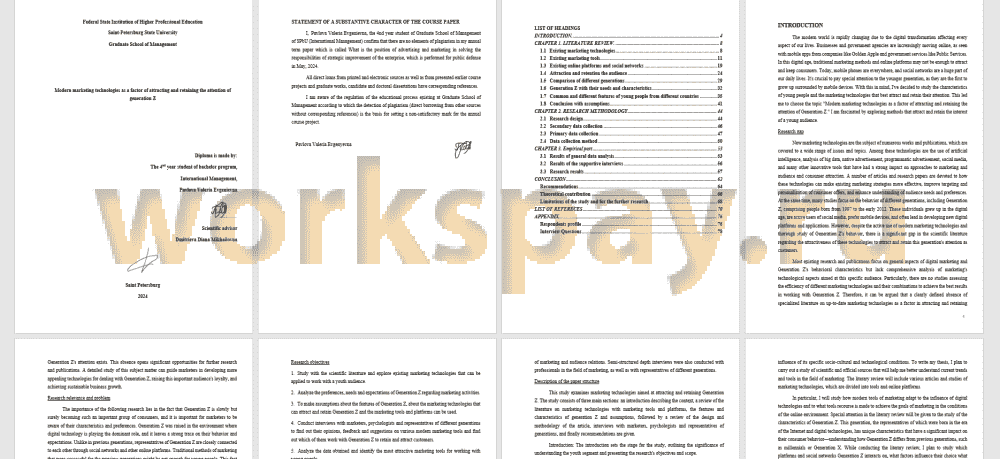
Тема: Modern marketing technologies as a factor of attracting and retaining the attention of generation Z
Закажите новую по вашим требованиям
Представленный материал является образцом учебного исследования, примером структуры и содержания учебного исследования по заявленной теме. Размещён исключительно в информационных и ознакомительных целях.
Workspay.ru оказывает информационные услуги по сбору, обработке и структурированию материалов в соответствии с требованиями заказчика.
Размещение материала не означает публикацию произведения впервые и не предполагает передачу исключительных авторских прав третьим лицам.
Материал не предназначен для дословной сдачи в образовательные организации и требует самостоятельной переработки с соблюдением законодательства Российской Федерации об авторском праве и принципов академической добросовестности.
Авторские права на исходные материалы принадлежат их законным правообладателям. В случае возникновения вопросов, связанных с размещённым материалом, просим направить обращение через форму обратной связи.
📋 Содержание
CHAPTER 1. LITERATURE REVIEW. 8
1.1 Existing marketing technologies 8
1.2 Existing marketing tools 11
1.3 Existing online platforms and social networks 19
1.4 Attraction and retention the audience 24
1.5 Comparison of different generations 29
1.6 Generation Z with their needs and characteristics 32
1.7 Common and different features of young people from different countries 35
1.8 Conclusion with assumptions 41
CHAPTER 2. RESEARCH METHODOLOGY 44
2.1 Research design 44
2.2 Secondary data collection 46
2.3 Primary data collection 47
2.4 Data collection method 50
CHAPTER 3. Empirical part 53
3.1 Results of general data analysis 53
3.2 Results of the supportive interviews 56
3.3 Research results 57
CONCLUSION 62
Recommendations 64
Theoretical contribution 66
Limitations of the study and for the further research 68
LIST OF REFERECES 70
APPENDIX. 76
Respondents profile 76
Interview Questions 78
📖 Введение
Research gap
New marketing technologies are the subject of numerous works and publications, which are covered to a wide range of issues and topics. Among these technologies are the use of artificial intelligence, analysis of big data, native advertisement, programmatic advertisement, social media, and many other innovative tools that have had a strong impact on approaches to marketing and audience and consumer attraction. A number of articles and research papers are devoted to how these technologies can make existing marketing strategies more effective, improve targeting and personalization of consumer offers, and enhance understanding of audience needs and preferences. At the same time, many studies focus on the behavior of different generations, including Generation Z, comprising people born from 1997 to the early 2012. These individuals grew up in the digital age, are active users of social media, prefer mobile devices, and often lead in developing new digital platforms and applications. However, despite the active use of modern marketing technologies and thorough study of Generation Z's behavior, there is a significant gap in the scientific literature regarding the attractiveness of these technologies to attract and retain this generation's attention as customers.
Most existing research and publications focus on general aspects of digital marketing and Generation Z's behavioral characteristics but lack comprehensive analysis of marketing's technological aspects aimed at this specific audience. Particularly, there are no studies assessing the efficiency of different marketing technologies and their combinations to achieve the best results in working with Generation Z. Therefore, it can be argued that a clearly defined absence of specialized literature on up-to-date marketing technologies as a factor in attracting and retaining Generation Z's attention exists. This absence opens significant opportunities for further research and publications. A detailed study of this subject matter can guide marketers in developing more appealing technologies for dealing with Generation Z, raising this important audience's loyalty, and achieving sustainable business growth.
Research relevance and problem
The importance of the following research lies in the fact that Generation Z is slowly but surely becoming such an important group of consumers, and it is important for marketers to be aware of their characteristics and preferences. Generation Z was raised in the environment where digital technology is playing the dominant role, and it leaves a strong trace on their behavior and expectations. Unlike in previous generations, representatives of Generation Z are closely connected to each other through social networks and other online platforms. Traditional methods of marketing that were successful for the previous generations might be not enough for young people. This fact requires the transition to such methods of marketing, which will be more innovative and technologically advanced in order to take into account and cater to their specific needs and preferences. Marketers need to be aware of which marketing tools and what online platforms work better for this demographic group.
Despite the popularization of the modern technologies, a great number of companies are currently suffering from great difficulties in terms of adapting to the fast-changing digital world. They cannot establish contact and adopt the existing technologies with Generation Z, and this makes them miss business opportunities. The current research will be aimed at filling the existing gap in terms of understanding how the modern technologies of marketing can be used to successfully attract and retain the representatives of Generation Z. The research will include the theoretical analysis and interviews among the youth of different countries in order to gain a better understanding of their characteristics and preferences, as well as to define the most attractive marketing technologies that they would be willing to use.
...
✅ Заключение
One of the key conclusions of the work was the understanding that Generation Z values authenticity and individuality of brands. They prefer companies that demonstrate social responsibility and environmental awareness. This requires marketers to include elements in their strategies that emphasize the company's contribution to the public good and sustainable development. Social and environmental initiatives supported by brands play an important role in attracting and retaining the attention of young people. Gamification, virtual and augmented reality technologies, content marketing and influencer marketing have proven effective in attracting and retaining the attention of Generation Z. These tools create interactive and engaging ways to interact with brands, which contributes to the formation of stable emotional connections with consumers. In particular, gamification allows users to interact with the brand in a playful way, which increases their engagement and loyalty.
Content personalization is another important aspect to consider when working with Generation Z. The use of big data and analytical tools allows companies to create customized offers that meet the interests and needs of each user. This significantly increases the chances of successfully attracting and retaining the attention of young people. The study also showed the need to optimize content for mobile platforms. Generation Z spends significant time in mobile applications and uses smartphones as the main tool for interacting with content and brands. Companies should take this into account when creating user-friendly and functional mobile
applications that use push notifications and other tools to maintain constant contact with the audience. Data analysis has confirmed that representatives of Generation Z have unique characteristics that distinguish them from previous generations. They strive for a work-life balance, appreciate the possibility of flexible schedules and remote work, and pay great attention to the reputation and values of brands. These features must be taken into account when developing marketing strategies aimed at attracting and retaining this audience.
The conducted research includes an analysis of modern marketing technologies and tools such as social networks, content marketing, influencer marketing, gamification, virtual and augmented reality, as well as personalized content. All these tools have shown their effectiveness in working with Generation Z and can be successfully used to create sustainable connections with this audience. An important aspect of the work was the study of different approaches to marketing in different countries and regions. The study showed that, despite global trends, there are significant differences in the behavior and preferences of young people depending on the cultural and social context. This highlights the need to adapt marketing strategies to the specifics of each region. In addition, the work included an analysis of the results of interviews with representatives of different generations, which made it possible to identify key differences and common features in their behavior and preferences.
...
📕 Список литературы
🖼 Скриншоты