Тема: M&A deals and investments in the global fashion market: legal analysis and current perspectives
Закажите новую по вашим требованиям
Представленный материал является образцом учебного исследования, примером структуры и содержания учебного исследования по заявленной теме. Размещён исключительно в информационных и ознакомительных целях.
Workspay.ru оказывает информационные услуги по сбору, обработке и структурированию материалов в соответствии с требованиями заказчика.
Размещение материала не означает публикацию произведения впервые и не предполагает передачу исключительных авторских прав третьим лицам.
Материал не предназначен для дословной сдачи в образовательные организации и требует самостоятельной переработки с соблюдением законодательства Российской Федерации об авторском праве и принципов академической добросовестности.
Авторские права на исходные материалы принадлежат их законным правообладателям. В случае возникновения вопросов, связанных с размещённым материалом, просим направить обращение через форму обратной связи.
📋 Содержание
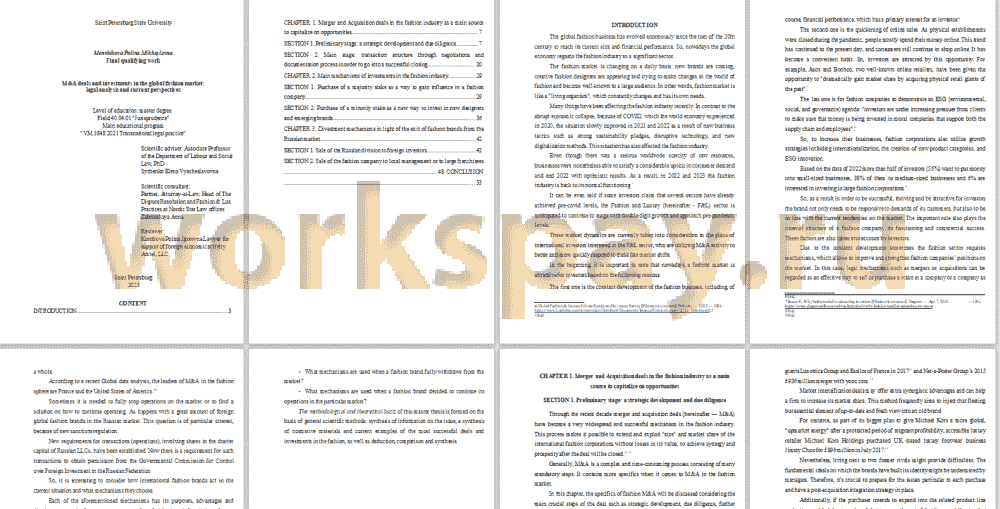
CHAPTER 1. Merger and Acquisition deals in the fashion industry as a main source to capitalize on opportunities 7
SECTION 1. Preliminary stage: a strategic development and due diligence 7
SECTION 2. Main stage: transaction structure through negotiations and documentation process in order to go into a successful closing 20
CHAPTER 2. Main mechanisms of investments in the fashion industry 29
SECTION 1. Purchase of a majority stake as a way to gain influence in a fashion company 29
SECTION 2. Purchase of a minority stake as a new way to invest in new designers and emerging brands 36
CHAPTER 3. Divestment mechanisms in light of the exit of fashion brands from the Russian market 42
SECTION 1. Sale of the Russian division to foreign investors 42
SECTION 2. Sale of the fashion company to local management or to large franchisees 48 CONCLUSION 53
📖 Введение
The fashion market is changing on a daily basis: new brands are coming, creative fashion designers are appearing and trying to make changes in the world of fashion and become well-known to a large audience. In other words, fashion market is like a "living organism", which constantly changes and has its own needs.
Many things have been affecting the fashion industry recently. In contrast to the abrupt economic collapse, because of COVID, which the world economy experienced in 2020, the situation slowly improved in 2021 and 2022 as a result of new business tactics such as strong sustainability pledges, disruptive technology, and new digitalization methods. This situation has also affected the fashion industry.
Even though there was a serious worldwide scarcity of raw resources, businesses were nonetheless able to satisfy a considerable uptick in consumer demand and end 2022 with optimistic results. As a result, in 2022 and 2023 the fashion industry is back to its normal functioning.1
It can be even said if some investors claim that several sectors have already achieved pre-covid levels, the Fashion and Luxury (hereinafter - F&L) sector is anticipated to continue to surge with double-digit growth and approach pre-pandemic levels.2
These market dynamics are currently taken into consideration in the plans of international investors interested in the F&L sector, who are utilizing M&A activity to better and more quickly respond to these fast market shifts.
In the beginning, it is important to note that nowadays a fashion market is attractive for investors based on the following reasons.
The first one is the constant development of the fashion business, including, of course, financial performance, which has a primary interest for an investor.3
The second one is the quickening of online sales. As physical establishments were closed during the pandemic, people mostly spend their money online. This trend has continued to the present day, and consumers still continue to shop online. It has become a convenient habit. So, investors are attracted by this opportunity. For example, Asos and Boohoo, two well-known online retailers, have been given the opportunity to "dramatically gain market share by acquiring physical retail giants of the past".4
The last one is for fashion companies to demonstrate an ESG (environmental, social, and governance) agenda: "investors are under increasing pressure from clients to make sure that money is being invested in moral companies that support both the supply chain and employees".5
So, to increase their businesses, fashion corporations also utilize growth strategies including internationalization, the creation of new product categories, and ESG innovation.
Based on the data of 2022 more than half of investors (56%) want to put money into small-sized businesses, 38% of them to medium-sized businesses and 6% are interested in investing in large fashion corporations.6
So, as a result in order to be successful, thriving and be attractive for investors the brand not only needs to be responsive to demands of its customers, but also to be in line with the current tendencies on the market. The important role also plays the internal structure of a fashion company, its functioning and commercial success. These factors are also taken into account by investors.
Due to the constant development sometimes the fashion sector requires mechanisms, which allows to improve and strengthen fashion companies’ positions on the market. In this case, legal mechanisms such as mergers or acquisitions can be regarded as an effective way to sell or purchase a stake in a company or a company as a whole.
...
✅ Заключение
As has been seen, the M&A deal process is drawn out and involves several factors. In the world of large fashion firms, it is one of the most suited company development mechanisms.
In most circumstances, the outcomes of M&A will result in synergy, increased wealth, and opportunity capitalization. As a result, there are more and more M&A transactions in the fashion industry every year.
When M&A deals are employed in the fashion business, it is not sufficient to take into account merely the standard M&A content and method. Fashion designs serve as intellectual property, and as such, the position of the lead designer, future integration plan, and even the history of the target firm must all be taken into consideration during the M&A process. If these factors are not sufficiently considered, a deal may not result in successful close and expected outcomes.
Then we face the situation that primary goals of making an investment in a fashion company may differ.
Some fashion companies, which have been on the market for quite a long time, have good financial indicators, want more development and strengthening their position in other international markets. In this case, the process of purchasing a majority stake helps both a vendor and a purchaser.
Purchasing a majority stake by an investment firm is helpful for bringing in more money and investment to achieve global growth in foreign markets. If a majority stake is bought by a retailer it will be helpful for a fashion company to expand sales channels. Purchasing a majority stake in a fashion online platform is helpful for the brands that want to provide a dynamic and engaging online environment. If a majority stake is bought by a brand management firm it can be useful for the fashion companies that want to improve their brand with the help of a marketing specialist, for example, to change marketing strategy.
Through analysis of the recent deals in the fashion market it is shown that there are so many companies, specializing on such purposes. They have a good expertise and deep knowledge of how to help a fashion brand.
In addition, regarding the purchase of a majority stake in a fashion company it is crucial that the brand's creator or designer remain a key player in business operations, assisting it in maintaining its distinct fashion DNA and preserving its historical values and peculiarities. The new majority shareholder should focus only on areas where the brand can be improved based on its specialisation and expertise.
А different situation is with the purchase of a minority stake. Here we can observe how the big players in the market, such as Luxury Ventures as a division of LVMH and Kering are looking for investments in such form. They have their criterion for investments.
According to the sustainability and active development of different fashion startups and young fashion brands, it is quite wide spreading and popular to make such investments.
It is important to note that the acquired young fashion brand or fashion start-up is not operated through investments in the form of buying minority ownership. Instead of actively trying to operate the firm on their own, the purchasers just express their forecasts for the path of the company and its management team.
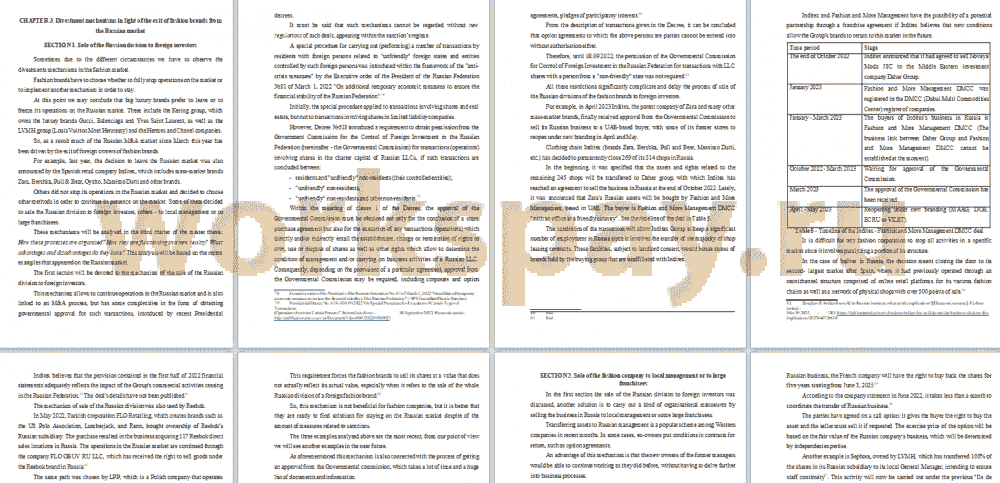
Sometimes the fashion market is facing divestment mechanisms as it has happened in the Russian fashion market. Global fashion brands have to choose how they must behave themselves in the current situation.
Some companies were selling their Russian subsidiaries to foreign investors, others - to local management or large franchisees. These mechanisms have their own advantages and disadvantages, but they are also closely connected with the current limitations of such transactions.
Transactions involving Russian subsidiaries of premium fashion and cosmetics businesses are currently far more difficult and need approval of Governmental commission.
...
📕 Список литературы
🖼 Скриншоты