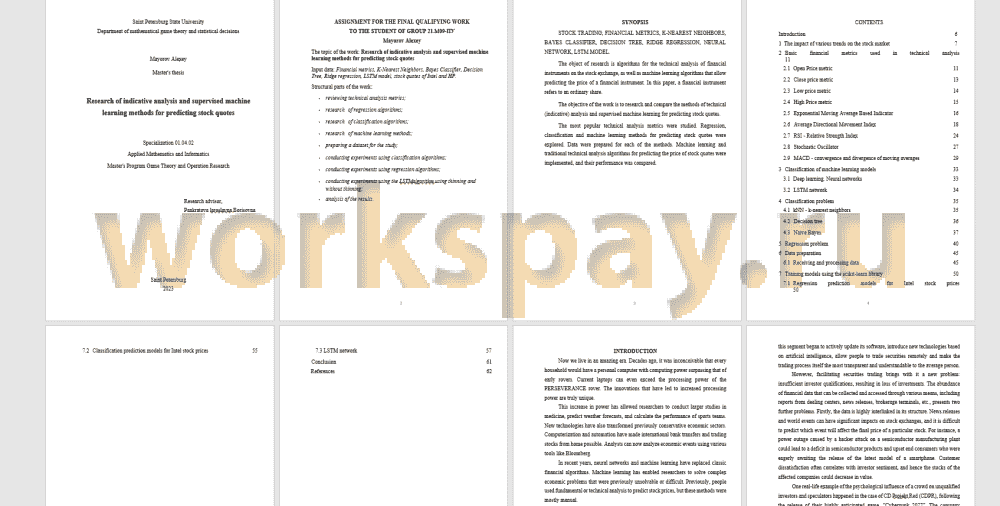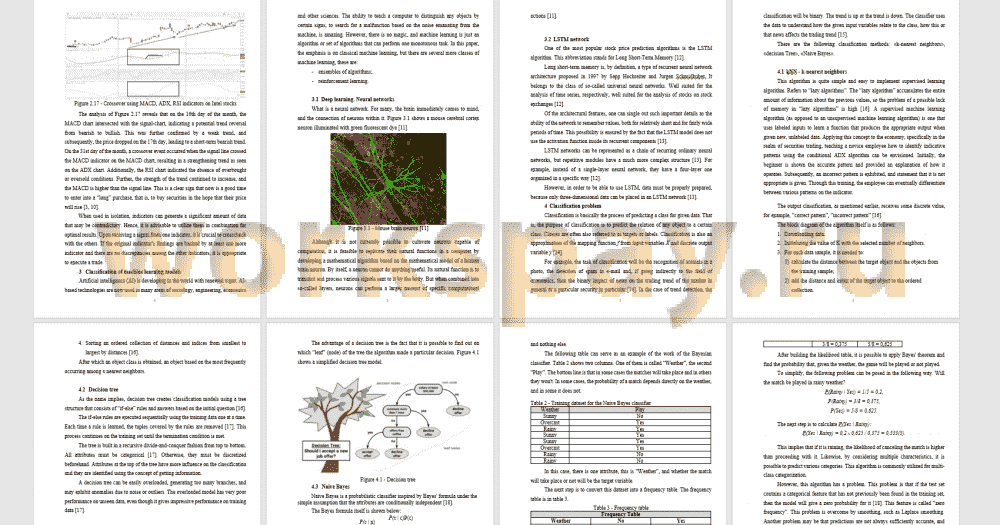
Тема: Research of indicative analysis and supervised machine learning methods for predicting stock quotes
Закажите новую по вашим требованиям
Представленный материал является образцом учебного исследования, примером структуры и содержания учебного исследования по заявленной теме. Размещён исключительно в информационных и ознакомительных целях.
Workspay.ru оказывает информационные услуги по сбору, обработке и структурированию материалов в соответствии с требованиями заказчика.
Размещение материала не означает публикацию произведения впервые и не предполагает передачу исключительных авторских прав третьим лицам.
Материал не предназначен для дословной сдачи в образовательные организации и требует самостоятельной переработки с соблюдением законодательства Российской Федерации об авторском праве и принципов академической добросовестности.
Авторские права на исходные материалы принадлежат их законным правообладателям. В случае возникновения вопросов, связанных с размещённым материалом, просим направить обращение через форму обратной связи.
📋 Содержание
Introduction 6
1 The impact of various trends on the stock market 7
2 Basic financial metrics used in technical analysis 11
2.1 Open Price metric 11
2.2 Close price metric 13
2.3 Low price metric 14
2.4 High Price metric 15
2.5 Exponential Moving Average Based Indicator 16
2.6 Average Directional Movement Index 18
2.7 RSI - Relative Strength Index 24
2.8 Stochastic Oscillator 27
2.9 MACD - convergence and divergence of moving averages 29
3 Classification of machine learning models 33
3.1 Deep learning. Neural networks 33
3.2 LSTM network 34
4 Classification problem 35
4.1 kNN - k-nearest neighbors 35
4.2 Decision tree 36
4.3 Naive Bayes 37
5 Regression problem 40
6 Data preparation 45
6.1 Receiving and processing data 45
7 Training models using the scikit-learn library 50
7.1 Regression prediction models for Intel stock prices 50
7.2 Classification prediction models for Intel stock prices 55
📖 Введение
This increase in power has allowed researchers to conduct larger studies in medicine, predict weather forecasts, and calculate the performance of sports teams. New technologies have also transformed previously conservative economic sectors. Computerization and automation have made international bank transfers and trading stocks from home possible. Analysts can now analyze economic events using various tools like Bloomberg.
In recent years, neural networks and machine learning have replaced classic financial algorithms. Machine learning has enabled researchers to solve complex economic problems that were previously unsolvable or difficult. Previously, people used fundamental or technical analysis to predict stock prices, but these methods were mostly manual.
Now, machine learning has taken a big step towards predicting stock prices. However, there are various problems with data collection, reactive influences of news agencies and fabricated incidents that can alter the algorithm's predictions. The main challenge in economic predictions is that they are influenced by a vast amount of loosely related information, making it almost impossible to process these events.
Therefore, an important question arises: is classical technical analysis better or are neural networks better? Would investors be better off relying on oscillators, robots, and charts or on neural networks that base their predictions on exchange data?
✅ Заключение
KRR method showed the smallest error result compared to all sequential models built by Keras and amounted to 0.21 of Mean Absolute Error metric and 0.92 of Mean Squared Error metric for estimation supplemented dataset and prediction dataset respectively. As for classifiers, the decision tree algorithm performed the best with an accuracy of 0.70, which is not ideal but still 1.42 times better than the Bayesian classifier algorithm and 1.20 times better than the kNN algorithm.
The LSTM model created using the Keras library and Tensorflow yielded Mean Squared Error metrics of 1.01 and 2.73 for the prediction dataset trained with and without thinning, respectively.
Based on the findings of the study, it can be inferred that traditional technical analysis methods are not less and might be even more effective than contemporary machine learning. In some cases, machine learning approaches might be a redundant overhead.
📕 Список литературы
🖼 Скриншоты